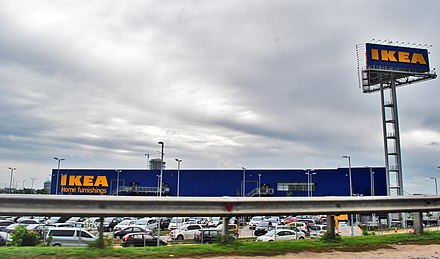
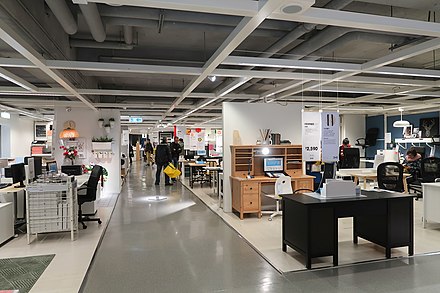
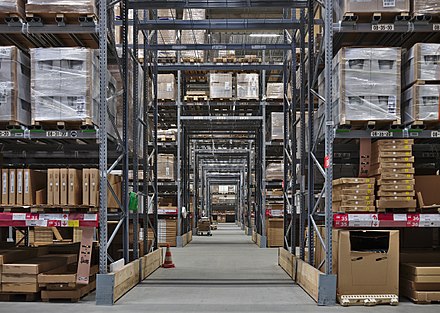
Traditional store layout IKEA stores are typically blue buildings with yellow accents (also Sweden's national colours). They are often designed in a one-way layout, leading customers counter-clockwise along what IKEA calls "the long natural way" designed to encourage the customer to see the store in its entirety (as opposed to a traditional retail store, which allows a customer to go directly to the section where the desired goods and services are displayed). There are often shortcuts to other parts of the showroom. The sequence first involves going through the furniture showrooms making note of selected items. The customer collects a shopping cart and proceeds to an open-shelf "Market Hall" warehouse for smaller items, visits the self-service furniture warehouse to collect previously noted showroom products in flat pack form. Sometimes, they are directed to collect products from an external warehouse on the same site or at a site nearby after purchase. Finally, customers pay for their products at a cash register. Not all furniture is stocked at the store level, such as particular sofa colours needing to be shipped from a warehouse to the customer's home or the store. Most stores follow the layout of having the showroom upstairs with the marketplace and self-service warehouse downstairs. Some stores are single level, while others have separate warehouses to allow more stock to be kept on-site. Single-level stores are found predominantly in areas where the cost of land would be less than the cost of building a 2-level store. Some stores have dual-level warehouses with machine-controlled silos to allow large quantities of stock to be accessed throughout the selling day. Most IKEA stores offer an "as-is" area at the end of the warehouse, just before the cash registers. Returned, damaged, and formerly showcased products are displayed here and sold with a significant discount, but also with a no-returns policy. Alternative smaller store formats This section may require cleanup to meet Wikipedia's quality standards. The specific problem is: no need to report every new store. Please help improve this section if you can. (November 2021) (Learn how and when to remove this template message) The vast majority of IKEA stores are located outside of city centers, primarily because of land cost and traffic access. Several smaller store formats have been unsuccessfully tested in the past (the "midi" concept in the early 1990s, which was tested in Ottawa and Heerlen with 9,300 m2 (100,000 sq ft), or a "boutique" shop in Manhattan). New formats for full-size stores A new format for a full-size, city center store was introduced with the opening of the Manchester (United Kingdom) store, situated in Ashton-under-Lyne in 2006. Another store, in Coventry, opened in December 2007. The store had seven floors and a different flow from other IKEA stores; however, it closed down in 2020 due to the site being deemed unsuitable for future business. IKEA's Southampton store that opened in February 2009 is also in the city center and built in an urban style similar to the Coventry store. IKEA built these stores in response to UK government restrictions blocking retail establishment outside city centers. Adaptation to Japanese market Japan was another market where IKEA performed badly initially, exited the market completely and then re-entered the Japanese market with an alternative store design and layout with which it finally found success. The IKEA entered the Japanese market in 1974 through a franchise arrangement with a local partner, only to withdraw in failure in 1986. Japan was one of the first markets outside its original core European market. Despite Japan being the second largest economy in the world at the time, IKEA did not adequately adapt its store layout strategy to the Japanese consumer. Japanese consumers did not have a culture of DIY furniture assembly, and many in the early days had no way to haul the flat-packs home to their small apartments. Nor did the store layouts familiar to European customers initially make much sense to Japanese consumers. So prior to re-entering the Japanese market in 2006, IKEA management did extensive local market research in more effective store layouts. One area of local adaptation was the room displays common to every IKEA store worldwide. Rather than just replicate a typical European room layout, the IKEA Japan management was careful to set up room displays more closely resembling Japanese apartment rooms, such as one for "a typical Japanese teenage boy who likes baseball and computer games". Inner-city stores IKEA also adapted its store location and services to the 'inner-city' format for the expansion in China, unlike other countries where IKEA stores for economic and planning restriction reasons tends to be more commonly just outside city centers due to planning restrictions. In China, planning restrictions are less of an issue than in other country markets due to the lack of cars for much of its customer base. Accordingly, in store design alternatives, IKEA has had to offer store locations and formats closer to public transportation since few customers had access to cars with which to buy and take-home DIY flat pack furniture. The store design alternative thinking and strategy in China has been to locate stores to facilitate access for non-car owning customers.[61] In fact, in some locations in China, IKEA stores can be found not in the usual suburban or near airport locations like in other countries, but rather places such as downtown shopping center with a 'mini-IKEA' store to attract shoppers. For example, one store design alternative trend that IKEA has implemented has been 'pop-up' stores along social media platforms in their advertising strategy for the first-time as a company to reach new customers demographics while still reinforcing its global brand locally in China. Small sized stores In Hong Kong, where shop space is limited and costly, IKEA has opened three outlets in the city, most of which have the one-way layout, part of shopping malls, small for IKEA stores but huge for Hong Kong retail stores. In addition to tailoring store sizes for specific countries, IKEA also alters the sizes of their products in order to accommodate cultural differences. In 2015, IKEA announced that it would be attempting a smaller store design at several locations in Canada. This modified store will feature only a display gallery and a small warehouse. One location planned for Kitchener is in the place formerly occupied by a Sears Home store. The warehouses will not keep furniture stocked, and so customers will not be able to drop in to purchase and leave with furniture the same day. Instead, they will purchase the furniture in advance online or in-store and order the furniture delivered to one of the new stores, for a greatly reduced rate. IKEA claims that this new model will allow them to expand quickly into new markets rather than spending years opening a full-size store. In 2020, IKEA opened at Al Wahda Mall in Abu Dhabi, UAE, which at 2,137 m2 (23,002 sq ft) was one of the smallest IKEA stores in the world. It also opened at 360 Mall in Kuwait and in Harajuku, Tokyo at the same year. The size of 360 Mall store was slightly larger than Al Wahda's despite bringing similar concept, at 3,000 m2 (32,000 sq ft), located at extension of the mall. As for IKEA Harajuku, the 2,500 m2 (26,910 sq ft), 7-storey store houses the chain's first and only konbini concept. In 2021, IKEA opened another of its smallest stores at the JEM Mall in Jurong East, Singapore. Replacing liquidated department store Robinsons, IKEA Jurong is only 6,500 m2 (70,000 sq ft) across three levels and the first in Southeast Asia that did not provide the “Market Hall” warehouse in its store. Also on the same year, IKEA opened its first small-store format in Bali, Indonesia. Replacing liquidated Giant hypermarket, IKEA Bali is dubbed as Customer Meeting Point, and eventually the smallest store so far, at 1,200 m2 (13,000 sq ft) of space. In 2022, another small-size store was opened inside Kings Mall (now known as Livat Hammersmith), Hammersmith, in February, at 4,600 m2 (50,000 sq ft), followed by a 9,400 m2 (101,000 sq ft) store inside Mall Taman Anggrek, Jakarta, which was opened on 7 April 2022.