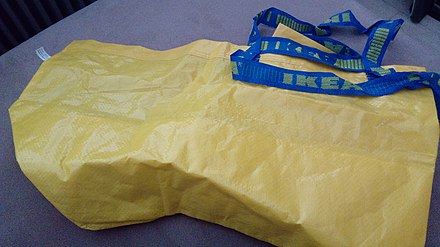
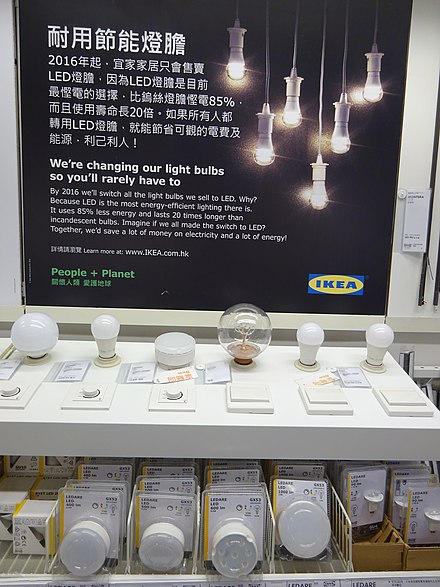
Umbrella initiatives After initial environmental issues like the highly publicized formaldehyde scandals in the early 1980s and 1992,[168][169][170] IKEA took a proactive stance on environmental issues and tried to prevent future incidents through a variety of measures.[171] In 1990, IKEA invited Karl-Henrik Robèrt, founder of the Natural Step, to address its board of directors. Robert's system conditions for sustainability provided a strategic approach to improving the company's environmental performance. In 1990, IKEA adopted the Natural Step framework as the basis for its environmental plan.[172] This led to the development of an Environmental Action Plan, which was adopted in 1992. The plan focused on structural change, allowing IKEA to "maximize the impact of resources invested and reduce the energy necessary to address isolated issues."[172] The environmental measures taken include the following: Replacing polyvinylchloride (PVC) in wallpapers, home textiles, shower curtains, lampshades and furniture—PVC has been eliminated from packaging and is being phased out in electric cables; Minimizing the use of formaldehyde in its products, including textiles; Eliminating acid-curing lacquers; Producing a model of chair (OGLA) made from 100% post-consumer plastic waste; Introducing a series of air-inflatable furniture products into the product line. Such products reduce the use of raw materials for framing and stuffing and reduce transportation weight and volume to about 15% of that of conventional furniture; Reducing the use of chromium for metal surface treatment; Limiting the use of substances such as cadmium, lead, PCB, PCP, and Azo pigments; Using wood from responsibly managed forests that replant and maintain biological diversity; Using only recyclable materials for flat packaging and "pure" (non-mixed) materials for packaging to assist in recycling.[172] Introducing rental bicycles with trailers for customers in Denmark.[173] In 2000, IKEA introduced its code of conduct for suppliers that covers social, safety, and environmental questions. Today IKEA has around 60 auditors who perform hundreds of supplier audits every year. The main purpose of these audits is to make sure that the IKEA suppliers follow the law in each country where they are based. Most IKEA suppliers fulfil the law today with exceptions for some special issues, one being excessive working hours in Asia, in countries such as China and India.[citation needed] As of March 2018, IKEA has signed on with 25 other companies to participate in the British Retail Consortium's Better Retail Better World initiative, which challenges companies to meet objectives outlined by the United Nations Sustainable Development Goals.[174] Product life cycle To make IKEA a more sustainable company, a product life cycle was created. For the idea stage, products should be flat-packed so that more items can be shipped at once; products should also be easier to dismantle and recycle. Raw materials are used, and since wood and cotton are two of IKEA's most important manufacturing products, the company works with environmentally friendly forests and cotton, whereby the excessive use of chemicals and water is avoided.[175] IKEA stores recycle waste and many run on renewable energy. All employees are trained in environmental and social responsibility, while public transit is one of the priorities when the location of stores is considered. Also, the coffee and chocolate served at IKEA stores is UTZ Certified.[176] The last stage of the life cycle is the end of life. Most IKEA stores recycle light bulbs and drained batteries, and the company is also exploring the recycling of sofas and other home furnishing products. Energy sources On 17 February 2011, IKEA announced its plans to develop a wind farm in Dalarna County, Sweden, furthering its goal of using only renewable energy to fuel its operations.[177] As of June 2012,[needs update] 17 United States IKEA stores are powered by solar panels, with 22 additional installations in progress,[178] and IKEA owns the 165 MW Cameron Wind farm in Cameron County on the South Texas coast[179] and a 42 MW coastal wind farm in Finland.[180] In September 2019, IKEA announced that they would be investing $2.8 billion in renewable energy infrastructure. The company is targeting making their entire supply chain climate positive by 2030.[181] Sourcing of wood Reportedly, IKEA is the world's largest buyer and retailer of wood.[22] In 2015, IKEA claimed to use 1% of world's supply of timber.[182] According to IKEA's 2021 Sustainability Report, 99.5% of all wood that the company uses is either recycled or meets the standards of the Forest Stewardship Council. IKEA states that "[a]ll wood used for IKEA products must meet our critical requirements that ensure it’s not (e.g.) sourced from illegally harvested forests [...]".[21] However, despite these claims, IKEA has been involved in unsustainable and most likely illegal logging of wood in multiple Eastern European countries in recent years, see Criticism of IKEA. IKEA owns about 136,000 acres of forest in USA and about 450,000 acres in Europe.[183][184] On 14 January 2021, Ikea announced that Ingka Investments had acquired approximately 10,840 acres (4,386 hectares) near the Altamaha River Basin in Georgia from The Conservation Fund. The acquisition comes with the agreement “to protect the land from fragmentation, restore the longleaf pine forest, and safe-guard the habitat of the gopher tortoise.”[185][186] IKEA is reported to be the largest private landowner in Romania since 2015.[22] Use of wood In 2011, the company examined its wood consumption and noticed that almost half of its global pine and spruce consumption was for the fabrication of pallets. The company consequently started a transition to the use of paper pallets and the "Optiledge system".[187] The OptiLedge product is totally recyclable, made from 100% virgin high-impact copolymer polypropylene (PP). The system is a "unit load alternative to the use of a pallet. The system consists of the OptiLedge (usually used in pairs), aligned and strapped to the bottom carton to form a base layer upon which to stack more products. Corner boards are used when strapping to minimize the potential for package compression." The conversion began in Germany and Japan, before its introduction into the rest of Europe and North America.[188] The system has been marketed to other companies, and IKEA has formed the OptiLedge company to manage and sell the product.[189] Packaging and bags Since March 2013, IKEA has stopped providing plastic bags to customers, but offers reusable bags for sale.[190] The IKEA restaurants also only offer reusable plates, knives, forks, spoons, etc. Toilets in some IKEA WC-rooms have been outfitted with dual-function flushers. IKEA has recycling bins for compact fluorescent lamps (CFLs), energy-saving bulbs, and batteries. In 2001, IKEA was one of the first companies to operate its own cross-border goods trains through several countries in Europe.[191] Electric vehicles IKEA has expanded its sustainability plan in the UK to include electric car charge points for customers at all locations by the end of 2013.[192][needs update] The effort will include Nissan and Ecotricity and promise to deliver an 80% charge in 30 minutes.[193] From 2016, IKEA has only sold energy-efficient LED lightbulbs, lamps and light fixtures. LED lightbulbs use as little as 15% of the power of a regular incandescent light bulb.[194] Investments In August 2008, IKEA announced that it had created IKEA GreenTech, a €50 million venture capital fund. Located in Lund (a university town in Sweden), it will invest in 8–10 companies in the coming five years with focus on solar panels, alternative light sources, product materials, energy efficiency and water saving and purification. The aim is to commercialise green technologies for sale in IKEA stores within 3–4 years.[195][196]